The path from a promising biologic drug product to an approved medicine begins long before Phase I Clinical Trials. For drug sponsors, one of the most critical early steps is satisfying the Chemistry, Manufacturing, and Controls (CMC) requirements in a FDA Investigational New Drug (IND) application.
While the FDA provides formal guidance, the CMC portion of your IND for biologics in 2025 is not just about compliance. Instead, it’s about proving process specifications, product quality, and patient safety.
One of the key challenges, particularly in early development, is the reproducibility of manufacturing processes. Product characterization and analytical controls play a significant role in ensuring product quality and continuity of clinical trial material supply. It is never too early to develop and implement robust analytical methods.
Understanding IND CMC Requirements for Biologics
A FDA’s CMC section provides detailed sections of what the biologic is, how it’s made, and how you ensure quality and consistency. For biologics, cell therapies, and gene therapies, this information is particularly critical because manufacturing variability of the biologics product can directly impact safety and efficacy.
The FDA notes in its formal CMC guidance that “The level of CMC information submitted should be appropriate to the phase of investigation”—meaning early-stage filings can be less complete but must still ensure participant safety.
2025 Trends Impacting CMC Submissions for Biologics
Several changes and trends in 2025 are shaping how sponsors approach their IND CMC requirements:
- Stronger Emphasis on Comparability Protocols – FDA expects early plans for handling manufacturing changes.
- Integration of Digital Quality Systems – Use of electronic batch records and AI-driven data integrity tools is becoming a competitive advantage.
- Heightened Focus on Supply Chain Resilience – Documenting secondary suppliers and contingency manufacturing plans is now common.
- Advanced Analytical Characterization – Sponsors are expected to use orthogonal methods to fully define biologic attributes.
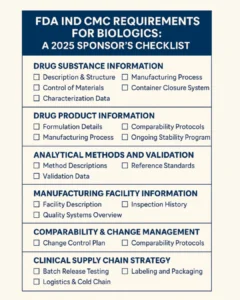
The 2025 Sponsor’s Checklist for FDA IND CMC Requirements
1. Drug Substance Information
- Description & Structure: Include molecular structure, amino acid sequence (for proteins), and any modifications.
- Manufacturing Process: Present an overview of cell line development, fermentation/bioreactor conditions, and purification.
- Control of Materials: Provide source, quality control, and traceability for raw materials, cell banks, and viral vectors.
- Characterization Data: Demonstrate identity, purity, potency, and stability.
2. Drug Product Information
- Formulation Details: List excipients with justifications, including compatibility studies.
- Manufacturing Process: Stepwise description, equipment, and in-process controls.
- Container Closure System: Material specifications and compatibility with the product.
- Microbial Control Strategy: For sterile products, detail aseptic processing and sterility assurance.
3. Analytical Methods and Validation
- Method Descriptions: Provide SOP summaries for identity, purity, potency, and safety testing.
- Validation Data: For critical assays, include method qualification or validation appropriate to the IND phase.
- Reference Standards: Describe creation, qualification, and stability of reference materials.
4. Stability Data
- Real-Time & Accelerated Studies: Even at early stages, provide available data supporting proposed storage.
- Ongoing Stability Program: Include your plan for continued stability monitoring throughout clinical trials.
5. Manufacturing Facility Information
- Facility Description: Include diagrams, cleanroom classifications, and process flow.
- Quality Systems Overview: Summarize GMP compliance measures, deviations handling, and release processes.
- Inspection History: Note FDA or foreign regulatory inspections, if applicable.
6. Comparability & Change Management
- Change Control Plan: Outline how you will evaluate and document manufacturing changes.
- Comparability Protocols: For anticipated changes, include analytical and functional comparison strategies.
7. Clinical Supply Chain Strategy
- Batch Release Testing: Provide acceptance criteria and timelines.
- Labeling and Packaging: Include mock-ups and ensure compliance with clinical labeling rules.
- Logistics & Cold Chain: Document validated shipping conditions and monitoring processes.
Best Practices for a Compliant and Competitive IND CMC
- Start CMC Early – Engage manufacturing and quality teams before preclinical milestones.
- Align with FDA Early – Schedule pre-IND meetings to confirm expectations.
- Leverage Quality by Design (QbD) – Identify critical quality attributes (CQAs) and process parameters (CPPs) early.
- Plan for Scale-Up – Even Phase 1 manufacturing choices can impact commercial scalability.
- Document Data Integrity – Use validated electronic systems and audit trails for all CMC records.
For deeper CMC strategy resources, see SCx CMC’s Biologics Development Insights.
Common Pitfalls That Delay IND Clearance
- Submitting incomplete stability data or omitting an ongoing stability plan.
- Inadequate method validation, especially for potency assays.
- Failure to justify excipient choices or container closure compatibility.
- Inconsistent manufacturing process descriptions between sections.
- Missing comparability protocols when manufacturing changes are anticipated.
Regulatory References
- FDA Guidance: CMC Information for an Investigational New Drug Application
- ICH Guidelines: Q5–Q11 series for biotechnological products and process validation.
Conclusion: Your 2025 IND CMC Roadmap
The FDA IND CMC requirements for biologics are more than a regulatory checklist—they are your first opportunity to show reviewers that you control your process, understand your product, and can deliver it consistently and safely.
Sponsors who prepare early, document thoroughly, and engage proactively with the FDA not only secure faster IND clearance but also set the stage for smoother BLA submissions.
In 2025, the sponsors who treat CMC as a strategic pillar—not a last-minute hurdle—will be the ones advancing therapies to patients faster and with fewer regulatory setbacks.
FAQ: FDA IND CMC Requirements for Biologics
It details the biologics’ composition, manufacturing process, analytical testing, stability, and quality control systems to ensure patient safety.
You must provide enough detail to ensure the product can be safely administered to humans, even if some validation data is preliminary.
Yes. Biologics require more extensive characterization, process controls, and stability considerations due to their complexity and sensitivity.
Start early, ensure internal CMC review before submission, and request FDA feedback during pre-IND meetings.
You can access it directly on the FDA CMC Guidance Page.